Home / Solar panel cleaning
Solar panel cleaningSolar Panel Cleaning Cost
Priced by the panel, not the square foot. What actually moves a solar panel cleaning quote — panel count, roof pitch and access — and when the wash is not worth what it costs.
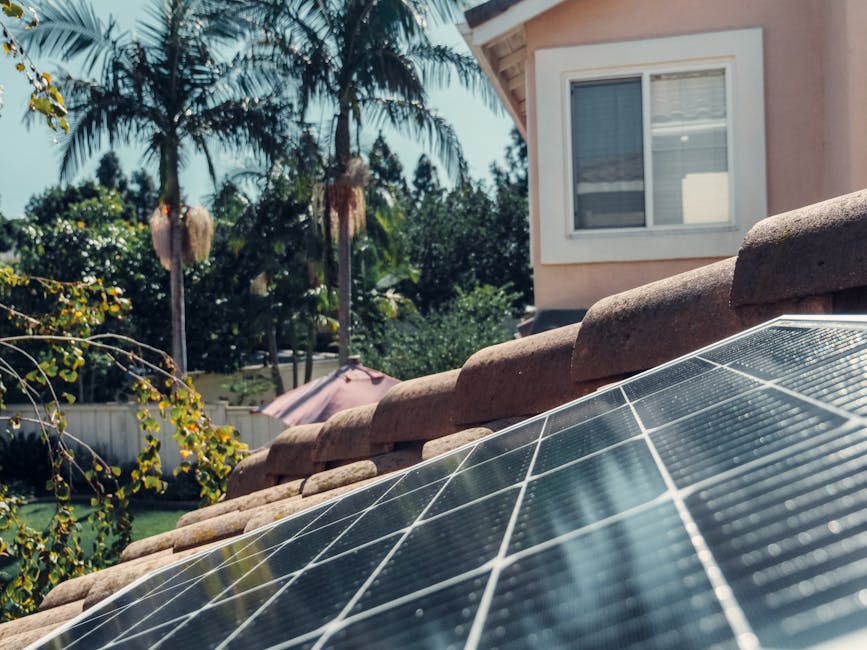
Professional solar panel cleaning runs about $5 to $20 per panel, so a typical 20–30 panel residential array lands near $150 to $450. The price is set by panel count, roof pitch and access — not by square footage, which is why this page does not use the per-square-foot model. Ground-level panels sit at the bottom of the band; a steep or second-storey roof pushes the same array toward the top.
Every other surface on this site is priced by its face. A wall is square feet of wall; a roof is square feet of roof. Solar panels are the exception, and it is why a cleaning quote for a solar array is the least comparable number in exterior cleaning. Two crews can look at the same roof, agree on the number of panels to the unit, and come back with $180 and $420 — both of them honest.
The reason is that an array is not one surface. It is a fixed number of discrete panels, each of which has to be wiped, rinsed and finished on its own, and the price is set by how many of them there are, how steeply they sit, and how hard they are to reach — not by the square footage they cover. This page is about what sits on those panels, what the crew has to do to them, and how each of those decisions shows up as money.
Why this page is priced by the panel, not the square foot
A 400-watt panel and a 300-watt panel are the same physical size, and cleaning them is the same amount of work. A wall that is twice as big takes twice as long; a solar array that is twice as big in watts is not twice as big in panels, and it is the panels that get cleaned. That is the whole reason the per-square-foot model does not transfer here.
There is a second reason, and it is about the gaps. Panels are mounted with a few inches of air between them so the roof can breathe and the array can shed heat, and a crew works each unit individually — reaching between and around, not sweeping a continuous face. The labour is per-panel, so the quote is per-panel. If a solar cleaning quote arrives priced by the square foot, it is either a crew that has not done many arrays or a crew that is pricing you by a number that has nothing to do with the work.
What the money is actually buying
Here is the same job broken into the lines a quote should contain. This decomposition is ours: the outer band of $5 to $20 a panel is what crews across our coverage area publish, and the split below is our modelling of where inside that band a given array lands. It is labelled rather than presented as measured, in line with our methodology.
| Line | Typical cost | When it applies |
|---|---|---|
| Base clean on a ground-level or walkable array | $5 – $10 / panel | Panels reachable from the ground or a low, gentle roof |
| Roof-mounted array, single storey | $8 – $15 / panel | Standard pitch, panels a few feet off the ground |
| Steep or second-storey roof | $12 – $20 / panel | Fall-protection gear and a longer setup; see below |
| Heavy soiling — bird droppings, pollen, salt film | add $2 – $5 / panel | Visible build-up that a rinse will not lift |
| Hard-water or mineral spotting | $50 – $150 per job | White scale that needs a dedicated treatment, not just a wash |
| Whole-array discount | −10 – 20% | Larger arrays, or panels cleaned with a house wash on the same visit |
Read down that column and the spread stops being mysterious. A ground-mounted array of twenty panels with nothing on them is a base-rate job. The same twenty panels on a steep second-storey roof, with a season of pollen and a few bird strikes on them, is three separate pieces of work — and the second quote is not padding, it is the first quote plus the things the cheap one did not look for.
The soiling problem: why cleaning matters at all
Soiling is the industry word for the dirt, dust and organic film that settles on a panel and blocks light before it reaches the cell. It is the one PV loss that is fully reversible — clean the glass and the output comes back — which is exactly why it is worth pricing. A peer-reviewed review of photovoltaic soiling, published in iScience and indexed by the U.S. National Library of Medicine, reports that “soiling caused in 2018 losses equivalent to 3%–4% of the global energy yield, with total missed revenues of at least 3 to 5 billion euros.” That is a global average across every climate; a single dirty array in a dusty or pollen-heavy region can sit well above it.
Rain does part of this job for free, and it is worth being honest about how much. A normal rain will rinse loose dust off a panel that is not too steeply tilted. What rain does not reliably remove is the film that actually costs you output: pollen that dries into a crust, salt spray that leaves a white residue, bird droppings that shade a cell, and the sticky organic film that holds all of it in place. Those are the reasons a professional clean exists, and they are also the reasons a quote for a dirty array is higher than a quote for a clean one.
Why the roof decides the price
The single biggest jump in a solar cleaning quote is not the panels. It is the roof they sit on.
Roof work is regulated for a reason. OSHA’s fall-protection standard for construction requires that “each employee on a walking/working surface (horizontal and vertical surface) with an unprotected side or edge which is 6 feet (1.8 m) or more above a lower level shall be protected from falling by the use of guardrail systems, safety net systems, or personal fall arrest systems.” A crew that is serious about a steep or second-storey array is carrying that gear, is trained in it, and is insured for the height — and all of that is real cost that lands in the per-panel number. A crew that quotes a steep roof the same as a ground array has either not priced the height or has not planned for it.
Access is the quieter half of the same story. A panel a few feet off the ground is reached with a ladder and a bucket. A panel on a second-storey roof may need a longer ladder, a harness anchor, or a water-fed pole long enough to reach the ridge without the crew stepping onto the slope. Every one of those is setup time, and setup time is what a per-panel rate is really paying for.
The method that costs what it costs
Solar glass is not siding, and the method is why a serious crew is not the cheapest one on the street. The standard professional approach is deionised water, a soft brush, and low pressure — the deionised water leaves no mineral residue as it dries, the soft brush lifts the film without scratching the glass, and the pressure is kept low enough to avoid forcing water into the panel edges or the junction boxes. A crew that carries a deionising system and a proper soft-brush rig has real equipment cost, and that is part of what you are paying for.
The warning that matters is the one about pressure. A pressure washer is the wrong tool for solar glass: too much pressure can scratch the surface, and it can drive water where it does not belong. If a quote is built around a pressure washer running at full tilt across the panels, that is not a discount, it is a risk. The honest version of this page is that the method is as much of the price as the panels are — and the method that protects a decades-long investment is not the method that is cheapest to run.
How often, and when it is not worth it
Most residential arrays do not need a professional clean every year. The U.S. Department of Energy notes that a photovoltaic system is built to last — “it is expected that inverters will need to be replaced at least once in the 25-year lifetime of a PV array” — and over that lifetime the panels themselves are the low-maintenance part. The question is not “how often,” it is “is there something on the glass that rain is not removing?”
Clean when you can see the problem: a pollen or salt film that has dried on, bird droppings, or a long dry spell with visible dust. Skip it when the array is ground-level and self-cleaning in your climate, or when the cost of the clean is more than the energy it recovers — which is a real calculation for a small array in a rainy region. The honest rule is that cleaning is worth it when there is something to remove, and not worth it when there is not.
Find a local pro
Solar panel cleaning is a listed service on every pressure-washing crew we cover, because it is the same equipment and the same roof access as a house wash. Around Myrtle Beach, where the salt air puts a film on rooftop arrays within a season, we point readers to the Grand Strand crew we recommend for solar panel cleaning. Outside the Grand Strand, every metro we cover is listed further down this page. And if what you want this year is the wash without the roof work, that job is priced on its own at house washing cost.